
LED Moving Head Wave Bar Light Buying Guide for Stage Lighting
Classification:
summary description]
Looking for a Smarter Way to Create Dynamic Stage Lighting?
When planning a lighting system, most buyers quickly discover a common challenge. Standard moving head lights are excellent for creating sharp beams or colorful washes, but covering a large stage with dynamic movement usually means installing more fixtures—and spending more on equipment, rigging, and programming.
An LED Moving Head Wave Bar Light approaches the problem differently.
Instead of relying on a single light source, it combines multiple LEDs in one linear fixture, allowing lighting designers to create sweeping movements, flowing pixel effects, synchronized color chases, and impressive aerial looks without filling the truss with dozens of individual lights.
For rental companies, event planners, clubs, and production teams, that often means more creative possibilities with fewer fixtures.
This guide explains what a moving head wave bar is, where it performs best, which specifications deserve your attention, and how to choose a fixture that will still meet your needs years from now.
What Exactly Is an LED Moving Head Wave Bar Light?
Think of it as a hybrid fixture.
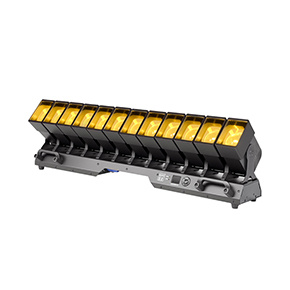
It delivers the movement of a traditional moving head while adding the wide coverage of an LED bar. Instead of producing one beam, several LED modules work together across the length of the fixture. In many professional models, each section can be controlled independently, opening the door to pixel mapping, animated color effects, running chases, and complex lighting sequences.
The fixture itself can pan and tilt just like a moving head, so designers aren’t limited to static linear effects. They can sweep the entire bar across the stage, rotate it through the air, or synchronize multiple fixtures into one seamless visual display.
That’s why these lights have become increasingly common in modern stage productions.
Why More Lighting Designers Are Choosing Wave Bar Fixtures
Technology has evolved, but audience expectations have evolved even faster.
Concertgoers, nightclub visitors, and event attendees expect lighting that feels energetic and immersive. Static lighting simply doesn’t create the same excitement.
Wave bar fixtures solve this by combining movement and animation in a single product.
Instead of installing several separate fixtures to build layered effects, one unit can already produce flowing color transitions, sweeping beams, and pixel animations simultaneously. The result feels richer without making the lighting rig unnecessarily complicated.
It’s also a practical decision. Fewer fixtures often mean less installation time, fewer power connections, and simplified maintenance over the life of the project.

Where Are LED Moving Head Wave Bar Lights Used?
One of the biggest advantages of this fixture is its flexibility.
Concert Stages
Large live performances benefit from wide lighting coverage and synchronized movement. Wave bars are frequently mounted behind performers, above the stage, or around LED video walls to add depth and motion throughout the show.
Nightclubs
Nightclubs demand constant visual energy.
Fast-moving beams, flowing RGB effects, and pixel animations help keep the lighting synchronized with the music, creating a more engaging atmosphere on the dance floor.
Corporate Events
Not every event requires aggressive lighting.
Corporate presentations, product launches, and award ceremonies often need clean, elegant effects instead. Wave bars can produce smooth movement and subtle color transitions that look professional on camera.
Weddings and Special Events
Many wedding production companies now incorporate intelligent lighting into reception designs. A few carefully positioned wave bars can dramatically transform entrances, first dances, or stage backdrops without overwhelming the venue.
Television Studios
TV productions appreciate consistency.
Because each LED section can be programmed individually, lighting directors have much greater control over how scenes appear from different camera angles.
Wave Bar Light or Traditional Moving Head?
This is probably the question buyers ask most often.
The answer isn’t that one is better than the other—they simply serve different purposes.
Traditional moving heads excel at producing concentrated aerial beams and spotlight effects. Wave bars, on the other hand, focus on movement across a wider area, offering flowing animations that are difficult to recreate with standard fixtures.
Many professional lighting designers combine both. Beam lights create intensity, while wave bars add texture, motion, and visual rhythm.
That combination usually delivers the most impressive results.
What Should You Pay Attention to Before Buying?
Price matters.
But experienced buyers know that specifications matter much more.
LED Quality
Not all LEDs perform equally.
Higher-quality LEDs provide smoother dimming, more accurate color mixing, better brightness consistency, and a longer service life. These differences become especially noticeable during live performances or television broadcasts.
Pixel Control
Pixel control is one of the main reasons people choose a wave bar in the first place.
The more individually controllable sections the fixture has, the more creative your programming can become. Complex animations, flowing effects, and detailed pixel mapping all depend on this feature.
Movement Performance
Movement should feel smooth—not mechanical.
Rapid pan and tilt speeds are useful, but positioning accuracy and quiet operation are equally important, particularly in theaters, studios, and conference venues.
Control Compatibility
Professional productions rarely rely on a single control method.
A quality fixture should support DMX512 and ideally offer compatibility with Art-Net, RDM, and pixel mapping software. That flexibility makes future system upgrades much easier.
Build Quality
A fixture may look impressive on paper, but internal components determine how well it performs after hundreds of shows.
Reliable cooling, durable motors, stable electronics, and solid housing construction all contribute to lower maintenance costs and longer operating life.
Questions Buyers Often Ask
Is It Suitable for Small Venues?
Yes.
Although these fixtures are popular on large stages, they also perform well in smaller venues. Brightness levels can usually be adjusted, and built-in automatic programs make operation straightforward even without advanced programming experience.
Do I Need Lighting Programming Skills?
Not necessarily.
Most fixtures include automatic and sound-active modes for immediate use.
However, if your goal is to create customized pixel effects or synchronize lighting with media servers, learning DMX programming will unlock far more creative possibilities.
How Many Fixtures Should I Buy?
There isn’t a universal answer.
A small nightclub may achieve excellent coverage with four fixtures, while a touring concert could require twenty or more. The correct quantity depends on stage dimensions, mounting positions, audience viewing angles, and the visual style you’re trying to achieve.
Planning the lighting design first usually prevents unnecessary purchases later.

Choosing the Right Manufacturer Matters
Even an excellent fixture can become a poor investment if technical support is unavailable.
Before placing an order, ask a few practical questions.
Does the manufacturer specialize in professional stage lighting?
Can they provide installation references from real projects?
Are spare parts available several years after purchase?
Do they test every fixture before shipping?
Will they offer programming assistance if needed?
These questions reveal far more about a supplier than a product brochure ever will.
Simple Maintenance Goes a Long Way
Professional lighting equipment represents a long-term investment.
Fortunately, keeping a wave bar in good condition doesn’t require complicated maintenance.
Clean the lenses regularly, remove dust from cooling fans, inspect moving components during routine servicing, and always transport fixtures in protective flight cases.
Small maintenance habits often prevent expensive repairs later.
Final Thoughts
An LED Moving Head Wave Bar Light isn’t designed to replace every other stage fixture. Instead, it fills a gap that traditional moving heads cannot.
It combines wide coverage, intelligent movement, pixel control, and creative programming into one versatile fixture capable of transforming the atmosphere of almost any venue.
Whether you’re expanding a rental inventory, upgrading a nightclub, or designing a concert stage from the ground up, taking the time to compare LED quality, movement accuracy, control options, and manufacturer support will almost always lead to a better investment.
The best lighting system isn’t necessarily the one with the most fixtures—it’s the one that creates the strongest visual experience while remaining reliable, efficient, and easy to operate.
Frequently Asked Questions
Can LED Moving Head Wave Bar Lights replace beam lights?
Not entirely. They serve different purposes. Beam lights create concentrated aerial effects, while wave bars provide wider movement, flowing animations, and pixel-based visual effects. Many professional productions use both together.
Do all models support DMX512?
Most professional fixtures do. Higher-end models often add Art-Net, RDM, and advanced pixel mapping capabilities for greater programming flexibility.
Are they suitable for rental companies?
Absolutely. Their versatility allows one fixture to cover multiple event types, making them a cost-effective choice for rental inventories that need maximum flexibility.
What should I prioritize when comparing suppliers?
Beyond product specifications, evaluate manufacturing experience, quality control, after-sales service, spare parts availability, and technical support. These factors often have a greater impact on long-term satisfaction than the initial purchase price.
Previous Page
More Cases


Online Message
Quick Links
Contact Information
Address: A8 Building Meiwang Industrial Park, Guangtang south street, Huadu District,Guangzhou, China.
Phone: +86 158 1889 3706
WhatsApp:+86 158 1889 3706