
Moving Wash Lights: Complete Buying Guide for Stage & Event Lighting
Classification:
summary description]
What Are Moving Wash Lights and Why Do So Many Venues Use Them?
If you’ve attended a concert, modern church, or nightclub with dynamic lighting, you’ve likely seen moving wash lights—even if you didn’t notice them.
Unlike beam lights, which create sharp shafts of light that cut through the air, moving wash lights are instead designed to fill a wide space with color. Beam lights are highly visible for their impact, while moving wash lights provide softer, broader illumination that enhances the overall atmosphere, highlights performers, and makes a stage feel larger and more dynamic.
This flexibility means a single fixture can provide a soft color wash during one scene and quickly reposition for a different look seconds later.
In summary, their versatility and adaptability are key reasons why moving wash lights remain one of the most widely used fixture types in professional lighting systems.

With their foundational role established, let’s compare moving wash lights and beam lights to help determine which fits your venue’s needs.
Buyers often ask this before ordering.
The short answer? It depends on what you’re trying to achieve.
To create visible aerial effects, choose beam lights. They produce focused beams ideal for concerts and large events.
In contrast to beam lights, which are intended for focused, dramatic visual effects, wash lights provide broad, even coverage.
Imagine a singer standing center stage. A beam light may create dramatic visual effects around the performer by projecting concentrated shafts of light. However, it doesn’t provide even illumination across the performance area. Moving wash lights, by comparison, have a wider beam angle, allowing them to cover the entire stage with smooth and consistent color.
In reality, most professional productions don’t choose one or the other. They use both.
Beam fixtures add excitement, and wash fixtures offer coverage. Together, they balance lighting design.
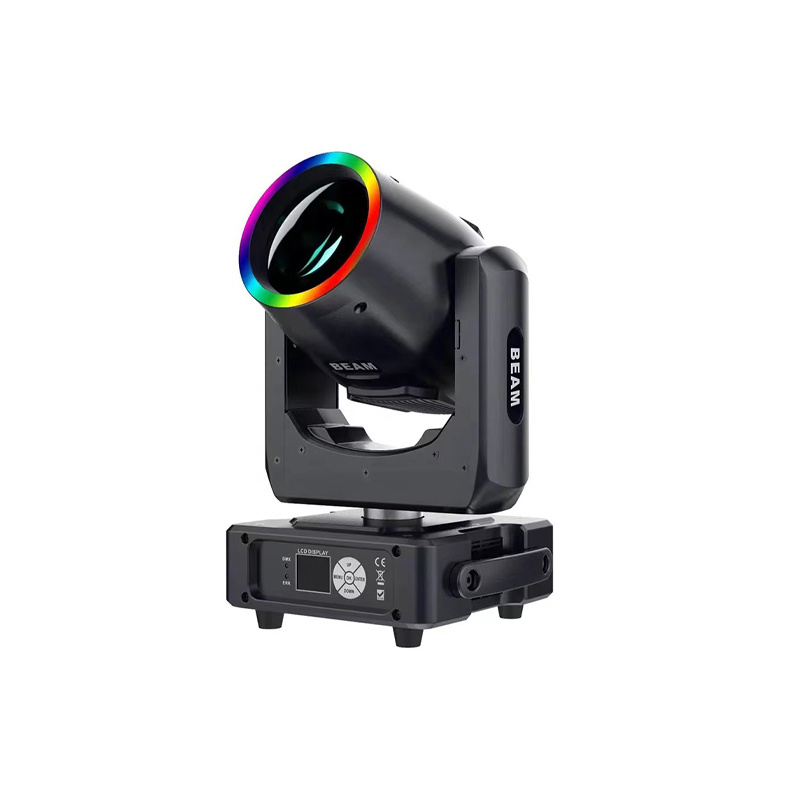
How to Choose the Right Moving Wash Lights for Your Venue
Many buyers focus on wattage. While output matters, it’s not always the most important.
A 300W fixture installed in the right environment can outperform a higher-powered fixture that’s poorly matched to the venue.
Before reviewing specs, ask these questions: How large is the venue?
- What is the mounting height?
- Will the fixtures be used indoors or outdoors?
- Do you need smooth color washes, audience lighting, or both?
- Will the system be installed permanently or used for touring events?
A small wedding venue may need six to eight LED moving wash lights. A concert may require twenty or more.
Often, the best choice isn’t the most powerful model, but the one that best suits your specific needs. Comparing moving wash lights, zoom range is often overlooked compared to brightness ratings. range often receives less attention. A wide zoom range gives designers creative freedom. One scene may require a narrow beam, the next a broad wash. During the next stage, it can expand to cover an entire stage.
This adaptability is particularly valuable for rental companies and event producers. A moving wash light with a 5°–60° zoom offers more versatility than a fixed-angle fixtureOffer more versatility than a fixture with a fixed beam. Cost is another important consideration, leading many to ask: Are expensive moving wash lights worth it?? it?
Not always, but extProfessionals consider more than price: reliability, brightness consistency, motor performance, cooling, and support affect costs. After-sales support all affects the total cost of ownership.
A fixture that fails during an event. For frequently used venues, quality moving wash lights mean fewer repairs and longer life. This results in fewer maintenance issues and a longer service life.
Consider your venue's needs and take the next step: evaluate your options, consult with a professional, or begin planning your lighting upgrade to benefit from the long-term value of quality moving wash lights.
Previous Page
Previous Page
More Cases


Online Message
Quick Links
Contact Information
Address: A8 Building Meiwang Industrial Park, Guangtang south street, Huadu District,Guangzhou, China.
Phone: +86 158 1889 3706
WhatsApp:+86 158 1889 3706