
Kinetic Lighting Equipment Guide for Events & Stages
Classification:
summary description]
When people first search for kinetic lighting equipment, they usually have one goal in mind: making a space feel alive. Not just brighter—but more dynamic, more immersive, more memorable.
But here’s the reality.
The moment you start researching, you run into a wall of technical terms—DMX winches, lifting heights, control protocols. It quickly becomes confusing.
This guide is written differently. No fluff. No overcomplicated explanations. Just what you actually need to know before making a decision.
Understanding Kinetic Lighting—Without the Jargon
At its core, kinetic lighting is simple.
It’s a system where lights move—up and down, sometimes in coordinated patterns—while changing color, brightness, and effects in sync with music or programming.
A typical setup includes:
- A motor (DMX winch) that controls vertical movement
- A light fixture (ball, tube, panel, etc.)
- A control system that tells everything what to do
That’s it. Movement + light + control.
What makes it powerful isn’t complexity—it’s how those three elements work together.
Why Kinetic Lighting Feels So Different
You’ve probably seen traditional stage lighting. It flashes, rotates, and changes colour.
Kinetic lighting does something else entirely.
It adds depth.
Instead of light coming from fixed positions, fixtures move through space. They drop, rise, pause mid-air, and reshape the visual environment in real time. Sometimes slowly, almost subtly. Other times, fast and aggressive.
That shift—from static to spatial—is why more venues are investing in it.
Where Kinetic Lighting Actually Works Best
Not every space needs it. But in the right setting, it changes everything.
Nightclubs
Crowds respond to motion. A ceiling filled with moving light points can completely redefine the atmosphere, especially when synced with music drops.
Concert Stages
Designers use kinetic systems to build layers—foreground, midground, background—all moving independently.
Events and Exhibitions
For brands, it’s about attention. A kinetic installation naturally draws eyes without needing explanation.
Weddings and Private Events
Smaller setups—like a grid of LED balls—can create a soft, floating visual effect that feels premium without being overwhelming.

Choosing the Right Equipment (Without Overbuying)
This is where most buyers go wrong.
They either:
- Buy too little and get underwhelming results
- Or over-invest in a system they don’t fully use
Let’s simplify the decision process.
Start with Your Space, Not the Product
Ask yourself:
- How high is the ceiling?
- Is there a truss or rigging structure available?
- How much weight can it support?
If your ceiling is under 4 meters, your options are naturally limited. No need to overcomplicate it.
Then Think About Visual Style
Different fixtures create different moods:
- LED balls → soft, floating, atmospheric
- LED tubes → clean, modern, structured
- Panels → more visual content-driven
- Beam rings → sharp, high-impact stage effects
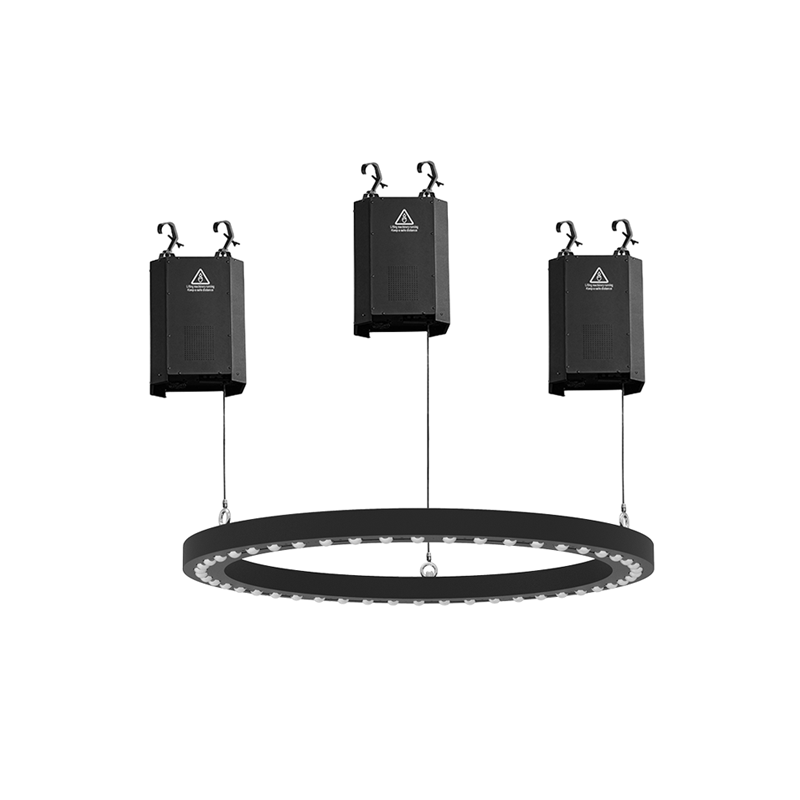
There’s no “best” option—only what fits your concept.
How Many Units Do You Really Need?
Here’s a rough guideline:
- 10–20 units → decorative accent
- 30–80 units → noticeable visual layer
- 100+ units → full-scale immersive effect
If you’re unsure, start smaller. A well-designed 30-unit setup often looks better than a poorly programmed 100-unit system.
Common Issues (And What Actually Fixes Them)
“Installation looks complicated”
It can be—but it doesn’t have to be.
Most problems come from unclear planning, not the equipment itself. A proper layout diagram and cable plan solve 80% of issues before installation even begins.
“The movement doesn’t look smooth.”
That’s usually not a hardware problem.
It’s programming.
Smooth motion comes from timing curves, not just motor quality. Even high-end systems can look bad with poor control settings.
“Everything goes out of sync.”
Check your DMX addressing first. Then your signal chain.
In many cases, it’s a simple configuration mistake—not a product failure.
“Maintenance might be difficult.”
In practice, it’s manageable.
Modern systems are modular. If a motor fails, you replace one unit—not the whole system.
What Does Kinetic Lighting Equipment Cost?
Prices vary, but here’s a realistic breakdown:
- Single unit (winch + light): $300–$800
- Mid-size system: $10,000–$30,000
- Large installations: $50,000+
What affects pricing the most?
- Lifting height
- Motor quality
- Fixture type
- Quantity
- Customization
One important note: cheaper isn’t always better. Stability matters more than saving a few hundred dollars per unit.
A Few Practical Tips Before You Buy
- Don’t skip testing—run a small setup first
- Plan your layout visually, not just technically
- Leave room for expansion
- Work with suppliers who can actually support you after purchase
These small decisions make a big difference later.
Final Thoughts
Kinetic lighting equipment isn’t just another upgrade—it’s a shift in how spaces are designed and experienced.
But it only works when it’s done right.
Focus less on specs, more on application.
Start with your space. Build gradually. Refine as you go.
That approach almost always leads to better results than trying to build everything at once.
FAQs
1. Is kinetic lighting suitable for small venues?
Yes, but keep the system simple. Even a small number of units can create a strong effect if designed properly.
2. Do I need special software to control it?
Not necessarily. Standard DMX controllers work, but software like Madrix gives you more flexibility.
3. How long does installation usually take?
Small systems can be installed in a day. Larger projects may take several days depending on complexity.
4. Can I expand the system later?
Yes. Most setups are scalable, which is why starting small is often a smart choice.
5. What’s the biggest mistake beginners make?
Focusing too much on hardware and not enough on design and programming.
Previous Page
Previous Page
More Cases


Online Message
Quick Links
Contact Information
Address: A8 Building Meiwang Industrial Park, Guangtang south street, Huadu District,Guangzhou, China.
Phone: +86 159 7549 0982
WhatsApp:+86 158 1889 3706