
Exploring the Art of Kinetic Lighting in Modern Design 2026
Classification:
summary description]
Kinetic lighting is no longer a niche concept reserved for large-scale concerts or experimental art spaces. As we move into 2026, it has become a defining element in modern design—reshaping how people experience architecture, interiors, and commercial environments.
For many users searching “Exploring the Art of Kinetic Lighting in Modern Design 2026”, the goal is simple: to understand how kinetic lighting works, why it matters, and whether it makes sense for their own space. This article answers those questions from a practical, user-first perspective.
Understanding Kinetic Lighting in Today’s Design Context
At its core, kinetic lighting refers to lighting systems that incorporate controlled movement. Fixtures can rise, descend, rotate, or reposition themselves in three-dimensional space, typically powered by DMX-controlled winches and intelligent control software.
What sets kinetic lighting apart is not just motion, but intentional movement. Every transition, pause, and formation change contributes to how a space feels. In modern design, that emotional response matters just as much as illumination.

Why Kinetic Lighting Continues to Grow in 2026
Design trends come and go. Kinetic lighting has stayed—and continues to evolve—for clear, user-driven reasons.
Spaces Must Feel Alive
Static environments struggle to hold attention. Whether it’s a hotel lobby, retail atrium, or entertainment venue, visitors expect more than decoration. Kinetic lighting introduces subtle or dramatic motion, giving spaces a sense of life and depth.
Flexibility Without Reconstruction
One of the biggest advantages for users is adaptability. A single kinetic lighting installation can support calm, minimalist scenes during the day and transform into a bold visual centerpiece at night. No physical redesign required.
Designed for Visual Media
In an era dominated by short-form video and digital content, kinetic lighting naturally creates moments worth capturing. For brands and venues, this visual appeal translates directly into marketing value.

Is Kinetic Lighting Only for Entertainment Venues?
This is one of the most common user concerns—and the answer is no.
While kinetic lighting gained popularity through concerts and clubs, its application in 2026 is far broader. Designers now integrate kinetic systems into:
- Commercial and mixed-use buildings
- Luxury hotels and resorts
- Corporate headquarters and innovation centers
- Museums, galleries, and exhibitions
- Brand showrooms and experiential retail spaces
In these environments, kinetic lighting often serves as a design feature, not a performance effect.
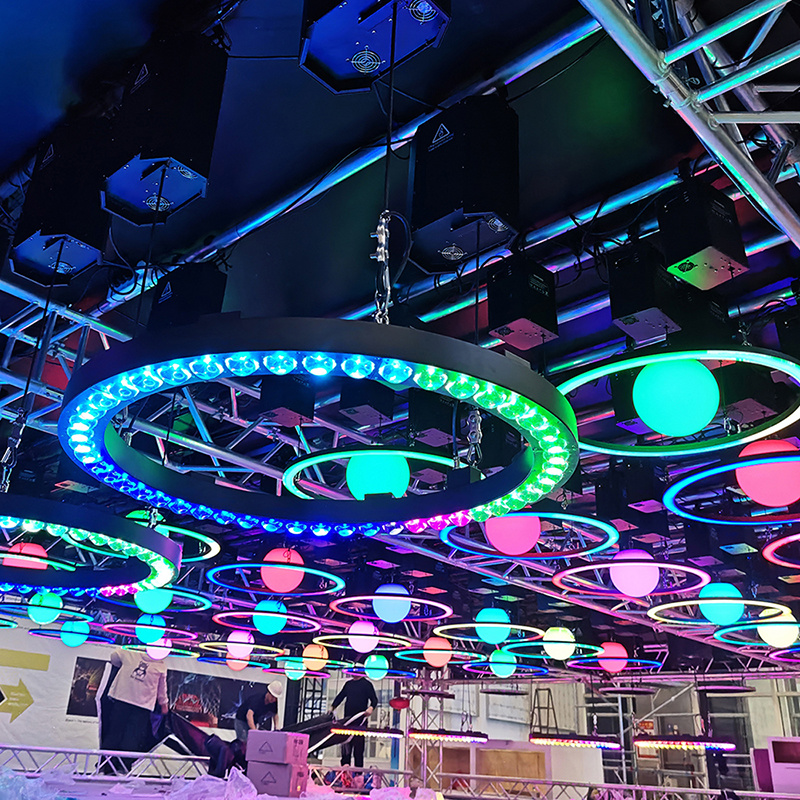
Popular Types of Kinetic Lighting Systems
Users researching kinetic lighting are often overwhelmed by options. The most widely used systems today include:
- Kinetic LED Tubes, valued for clean lines and architectural harmony
- Kinetic Light Balls or Spheres are often used to create immersive ceiling installations
- Kinetic Rings, popular in artistic and stage-centered designs
- Kinetic Beam and Pixel Fixtures, combining movement with precise lighting effects
Each type serves a different purpose, depending on the scale of the space and the desired visual impact.
How Kinetic Lighting Solves Real Design Challenges
From a user standpoint, kinetic lighting is not just visually impressive—it is functional.
Filling Vertical Space
Large interiors often suffer from unused overhead volume. Kinetic lighting brings that space into play, creating visual balance and guiding attention upward.
Adapting to Multiple Scenarios
A single venue may host different events, audiences, or moods. Kinetic lighting allows designers to shift atmospheres instantly through programmed movement and lighting scenes.
Strengthening Visual Identity
Custom motion patterns, color palettes, and lighting sequences help spaces develop a recognizable visual signature—something static fixtures struggle to achieve.
Practical Considerations Before Installation
Before committing to kinetic lighting, users should evaluate a few essential factors.
First, ceiling height and load capacity must be sufficient to support motorized systems safely.
Second, the lighting control system should integrate smoothly with existing DMX or show-control setups.
Third, long-term reliability matters. High-quality winch motors, cables, and safety mechanisms are critical, especially in permanent installations.
Good kinetic lighting design is never accidental. Planning, testing, and professional coordination make the difference between a striking installation and a problematic one.
The Future Role of Kinetic Lighting in Modern Design
Looking beyond 2026, kinetic lighting represents a broader shift in design philosophy. Spaces are no longer static backdrops. They are responsive, adaptive, and experience-driven.
For users—whether designers, venue owners, or brand managers—kinetic lighting offers a way to create environments that evolve, engage, and remain visually relevant over time.
Conclusion
Exploring the art of kinetic lighting in modern design is ultimately about understanding how movement, light, and space interact. When used thoughtfully, kinetic lighting becomes more than a visual effect. It becomes part of the architecture itself.
For anyone researching kinetic lighting in 2026, the focus should be on usability, flexibility, and long-term value. The most successful projects are not the most complex—but the most intentional.
More Cases


Online Message
Quick Links
Contact Information
Address: 2nd Floor, Building A8, Meiwan Science and Technology Park, Huadu District, Guangzhou City, Guangdong Province
Phone: +86 159 7549 0982
WhatsApp:+86 158 1889 3706