
Moving Theater Lights: A Practical Buying Guide
Classification:
summary description]
Good theater lighting does more than illuminate a stage. It helps audiences see performers, separates people from scenery, changes the mood between scenes, and supports the story without distracting from it.
Traditional Fresnels, profile lights, and PAR fixtures still have an important role. However, moving theater lights give lighting designers much more flexibility. A motorized fixture can change its position, color, beam angle, focus, or effects without being manually repositioned.
That makes moving lights useful for plays, musicals, dance performances, concerts, school theaters, and multipurpose venues.
The challenge is choosing the right fixture. A powerful moving head is not automatically a good theater light. Noise, color quality, beam control, dimming, and installation position all matter.
What Are Moving Theater Lights?
Moving theater lights are motorized stage fixtures that can be controlled remotely during a performance.
Most moving heads provide pan and tilt movement. Depending on the model, they may also offer zoom, focus, color mixing, gobos, prism effects, frost, and strobe functions.
DMX512 is widely used to control these functions. Larger systems may also use Art-Net or sACN.
The key is not how many functions a fixture has, but whether those functions are useful for your production. A drama may need slow, accurate movement and smooth dimming, while a musical may require wider coverage and faster scene changes.
Why Use Moving Lights in a Theater?
The main advantage is flexibility.
A fixed light normally stays focused on one area. A moving fixture can be repositioned through the lighting console, allowing one fixture to serve different areas during different scenes.
This is particularly useful in multipurpose venues. A theater may host a play one week and a concert or dance performance the next.
Moving lights can also simplify scene changes. Once positions, colors, and intensities have been programmed, the lighting console can recall them during the show.
Which Moving Lights Should You Choose?
Moving Wash
Moving wash lights provide broad, softer coverage. They are useful for stage washes, backgrounds, dance performances, and large scenic areas.
If the stage layout changes frequently, a fixture with zoom can be more practical than one with a fixed beam angle.
Moving Spot or Profile
Moving spot fixtures provide more controlled illumination. Depending on the model, they may include gobos, focus, zoom, and framing functions.
They work well for performer highlights, scenic patterns, and specific stage areas.
Moving Beam
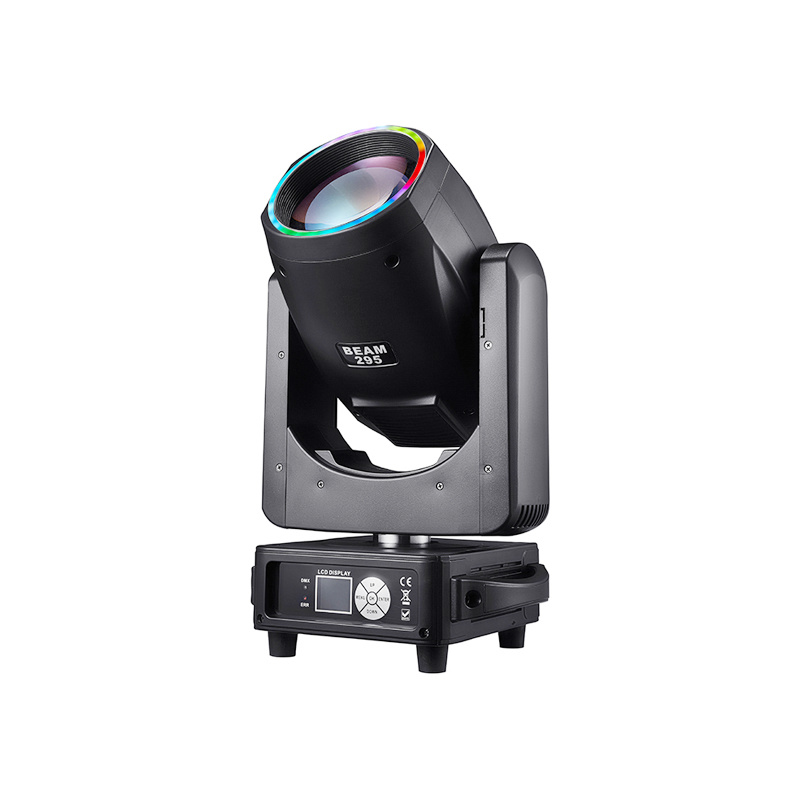
Moving beam lights produce narrow, concentrated beams. They are common in concerts but can also add dramatic effects to musicals and theatrical productions.
They should not replace proper performer lighting. A narrow beam may look impressive through haze while providing very little useful coverage.

What Specifications Matter?
Light Output
Do not compare fixtures by LED wattage alone.
Stage size, throw distance, beam angle, optics, and ambient light all affect usable output. Ask suppliers for photometric information whenever possible.
Beam Angle and Zoom
A narrow beam concentrates light, while a wide beam covers more area. A moving light with zoom can provide both options and is often useful for venues with changing layouts.
Color Quality
For theater, color quality matters because audiences need to see faces, costumes, and scenery naturally.
Check CRI and available white-light specifications. If possible, test the fixture with performers rather than relying only on product photos.
Dimming
Smooth dimming is essential for theatrical cues. Uneven fading can make slow transitions look harsh, especially at low intensity.
Noise
Noise can become a serious issue in theaters.
A moving head designed for a loud concert may be acceptable there but distracting during a quiet play. Check fan and motor noise before purchasing, particularly for small venues.
Where Should Moving Theater Lights Be Installed?
The best position depends on the lighting task.
Front lighting is mainly used for performer visibility. Here, accurate positioning and good color quality are important.
Side lighting adds depth and can define performers’ movement, making it useful for dance productions.
Back lighting helps separate performers from the scenery and can create silhouettes or atmospheric effects.
Overhead and truss positions provide flexible coverage and work well in venues where stage layouts change.
Before installation, also consider fixture weight, rigging capacity, power distribution, safety requirements, and maintenance access.

How Are Moving Theater Lights Controlled?
DMX512 remains one of the most common control methods for professional stage lighting.
Each fixture receives a DMX address and uses a defined number of channels. The lighting console can then control intensity, color, pan, tilt, zoom, focus, gobos, and effects.
More channels do not always mean a better fixture. A highly complicated fixture may take longer to program, particularly in a small theater with a simple lighting console.
Common Buying Mistakes
Choosing by wattage alone: Higher LED power does not automatically mean better stage coverage.
Buying concert fixtures for quiet theater: High-output fixtures may produce more fan or motor noise than a drama venue can tolerate.
Using too many effects: Strobe, fast movement, gobos, and color changes can look impressive, but theatrical lighting usually benefits from restraint.
Ignoring maintenance: Moving heads contain motors, fans, and electronics. Make sure technicians can access them after installation.
Skipping a sample test: Before placing a large order, test dimming, color quality, movement, noise, zoom, focus, and DMX response.
How Many Moving Theater Lights Do You Need?
There is no universal number.
Start by defining the lighting tasks:
- Front light for visibility
- Side light for depth
- Back light for separation
- Wash for broad coverage.
- Spot/profile for controlled highlights
- Beam fixtures for selected effects
Then consider stage dimensions, mounting height, fixture output, beam angle, and existing equipment.
This approach is more useful than deciding in advance that a theater needs a specific number of moving heads.
Moving Theater Lights Buying Checklist
Before placing an order, check:
- Stage size and throw distance
- Light output and beam angle
- Zoom range
- Dimming quality
- Color quality
- Operating noise
- DMX compatibility
- Fixture weight
- Maintenance access
- Spare parts availability
- Warranty and technical support
For larger projects, request a sample or demonstration before committing to a bulk purchase.
FAQ
Are moving head lights good for theater?
Yes. They can provide flexible positioning, color control, and scene changes. For theater, smooth dimming, accurate movement, good color quality, and low noise are often more important than extreme output.
Do moving theater lights need DMX?
Most professional fixtures support DMX512. Some also support Art-Net or sACN for network-based lighting control.
Are LED moving lights better than traditional theater lights?
LED moving lights offer flexibility and remote positioning, while traditional fixtures can still provide excellent front light and predictable coverage. Many professional systems use both.
How much do moving theater lights cost?
Prices vary according to output, optics, LED source, control features, construction, and manufacturer. Compare the complete specification rather than choosing solely by unit price.
Final Thoughts
The best moving theater lights are not necessarily the brightest or most feature-packed fixtures.
Start with the production. Consider the stage size, throw distance, required coverage, noise level, color quality, and control system. Then choose fixtures that match those needs.
For many theaters, a combination of moving washes, moving spots, and traditional fixtures provides a more useful lighting system than relying entirely on powerful moving heads.
The goal is simple: give the lighting designer enough control to support the performance while keeping the equipment itself out of the spotlight.
Previous Page
Previous Page
More Cases


Online Message
Quick Links
Contact Information
Address: A8 Building Meiwang Industrial Park, Guangtang south street, Huadu District,Guangzhou, China.
Phone: +86 158 1889 3706
WhatsApp:+86 158 1889 3706